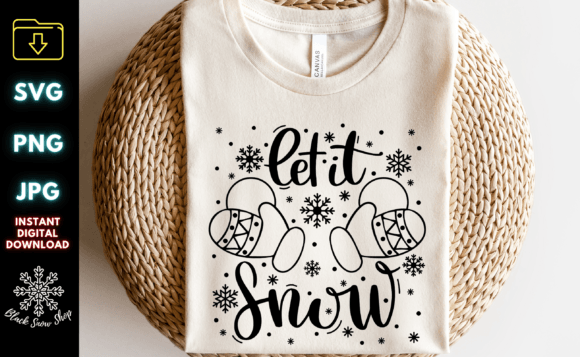
Let It Snow Snowball Christmas SVG: A Designer’s Review
As a professional embroidery digitizer and product reviewer, I approach every new graphic asset with a specific question: will this actually stitch out cleanly on fabric? When evaluating the Let It Snow Snowball Christmas Svg, my first impression was immediately positive regarding its versatility. The design captures a playful, nostalgic winter mood without relying on overly complex gradients or microscopic details that often plague digital-to-fabric conversions. For those of us in the Crafts industry, finding Graphics that translate seamlessly from screen to textile is rare. This snowball theme offers a balanced composition that feels intentional rather than cluttered, making it a strong candidate for both personal holiday projects and commercial inventory.
First Impressions and Visual Personality
The visual personality of this design leans into cozy minimalism. Unlike intricate Victorian-style holiday art that requires thousands of stitches and heavy stabilizer, this snowball concept suggests clean lines and manageable density. As an experienced designer, I look for shapes that hold their structure during the stitching process. The circular motif of a snowball is inherently stable, reducing the risk of fabric puckering that often occurs with tall, thin lettering or jagged edges. The layout feels centered and grounded, which is crucial when placing designs on curved surfaces like caps or uneven textures like knit sweatshirts. It strikes the right balance between whimsy and professionalism, avoiding the amateurish clip-art aesthetic that can devalue a handmade product.
Real-World Application: The Custom Sweatshirt Test
To truly evaluate this asset, I mentally ran through a recent client request for a batch of unisex holiday sweatshirts intended for a local boutique. The client wanted a design that felt vintage but crisp. The Let It Snow Snowball Christmas Svg fits this brief perfectly because of its scalable vector nature. When preparing a sweatshirt embroidery project, the fleece backing and stretchy knit face present challenges. A design with too much fill stitch density can cause the garment to warp or feel like armor against the skin.
In this scenario, I would utilize the SVG file to create a custom applique design version. By using the snowball shape as a guide for a felt or cotton applique, I could reduce the overall stitch count significantly while adding tactile value. The remaining elements, likely the "Let It Snow" text, would work beautifully as a satin stitch border or a delicate running stitch accent. This hybrid approach elevates the perceived value of the custom apparel. Customers are more likely to purchase a garment that has dimensional texture rather than a flat, dense patch of thread. Furthermore, the high-resolution PNG (2000 x 2000 px) included in the download allows me to create accurate printable mockups for the client’s approval before a single needle penetrates fabric, ensuring the placement and scale meet their expectations.
Navigating Fabric Limitations and Hoop Sizes
While the design is versatile, practical judgment dictates caution in specific applications. If you are planning baby embroidery on onesies or delicate muslin, the standard size may be too aggressive. Baby fabrics require minimal penetration to maintain softness and safety. In these cases, I recommend resizing the SVG down and simplifying any internal details to prevent stiffness. Always verify your hoop size capabilities before committing; a design that looks airy at six inches can become dangerously dense if shrunk to two inches without adjusting the stitch parameters.
Textured fabrics like terry cloth towels or boucle also demand attention. The smooth curves of the snowball can get lost in high-pile fabrics. For a tote bag design or kitchen towel, consider adding a knockdown stitch base or choosing a heavier weight thread to ensure the design sits on top of the fabric texture rather than sinking into it. Conversely, on dark fabrics, contrast is king. The white snowball element provides natural contrast, but if the accompanying text is also light, it may vanish on cream or pastel garments. Always test thread colors against your specific substrate. A design that pops on navy might fail completely on heather gray.
Commercial Viability for Etsy Sellers and Makers
For the Etsy seller or small business owner, time is money. The inclusion of multiple file formats (SVG, JPG, PNG) makes this asset a powerhouse for mixed-media businesses. You aren't limited to just one revenue stream. While I am reviewing this primarily as a machine embroidery design foundation, the high-res raster files allow you to offer matching stickers, mug decals, or signage. This consistency across product lines builds brand recognition and trust.
However, a critical note for commercial embroidery users: always confirm licensing. Just because a file is an instant download does not automatically grant permission to sell finished goods or distribute the digital file itself. Responsible craft business owners verify terms before listing products. Assuming the license permits finished sales, this design has high giftability. It avoids specific year markers or names, making it a timeless holiday embroidery staple that can remain in your catalog for years without feeling dated. This longevity improves ROI on your design assets.
Essential Technical Notes for Stitch Success
Before loading this design into your machine, adhere to these professional best practices to ensure a premium finished product:
- Digitizing Verification: Remember that an SVG is a vector graphic, not a native embroidery file (like .DST or .PES). You must digitize this artwork or hire a digitizer to convert it into stitches. Do not rely on auto-digitizing software for complex curves; manual adjustment ensures the satin stitch follows the snowball's contour smoothly without jagged edges.
- Stabilizer Selection: Match your stabilizer to the fabric, not just the design. For the sweatshirt scenario mentioned earlier, use a medium-weight cutaway to support the stretch. For woven tote bags, a tear-away may suffice. Testing on scrap fabric is non-negotiable.
- Detail Inspection: Zoom in on the SVG before digitizing. Ensure any text elements are thick enough to accommodate satin columns. If the font is too thin, modify it in your vector software first to prevent thread breaks or poor coverage during stitching.
- Mockup Strategy: Use the provided 2000 x 2000 px JPG to create realistic previews. Place it over photos of blank garments to check scale. A design that looks perfect on screen might appear tiny on an adult XL hoodie. Adjustments are cheaper in Photoshop than on actual fabric.
- Thread Contrast Check: View your digitized file in black and white within your embroidery software. This removes color bias and reveals whether the design relies solely on hue for definition or if it has sufficient structural contrast to read clearly in monochrome stitching.
Final Verdict on Design Utility
The Let It Snow Snowball Christmas Svg earns its place in a professional maker’s library due to its structural integrity and cross-platform utility. It respects the physical limitations of thread and fabric while offering enough artistic charm to engage buyers. Whether you are creating a personalized gift for a family member or stocking your shop with small shop product staples, this design provides a reliable foundation. Success lies not just in the file you download, but in how thoughtfully you adapt it to the tangible reality of needles, thread, and fabric. Treat it as a blueprint for creativity, apply proper digitizing techniques, and it will serve your business well through many holiday seasons.